
Microsoft's AI Agent Framework Was Poisoned on PyPI
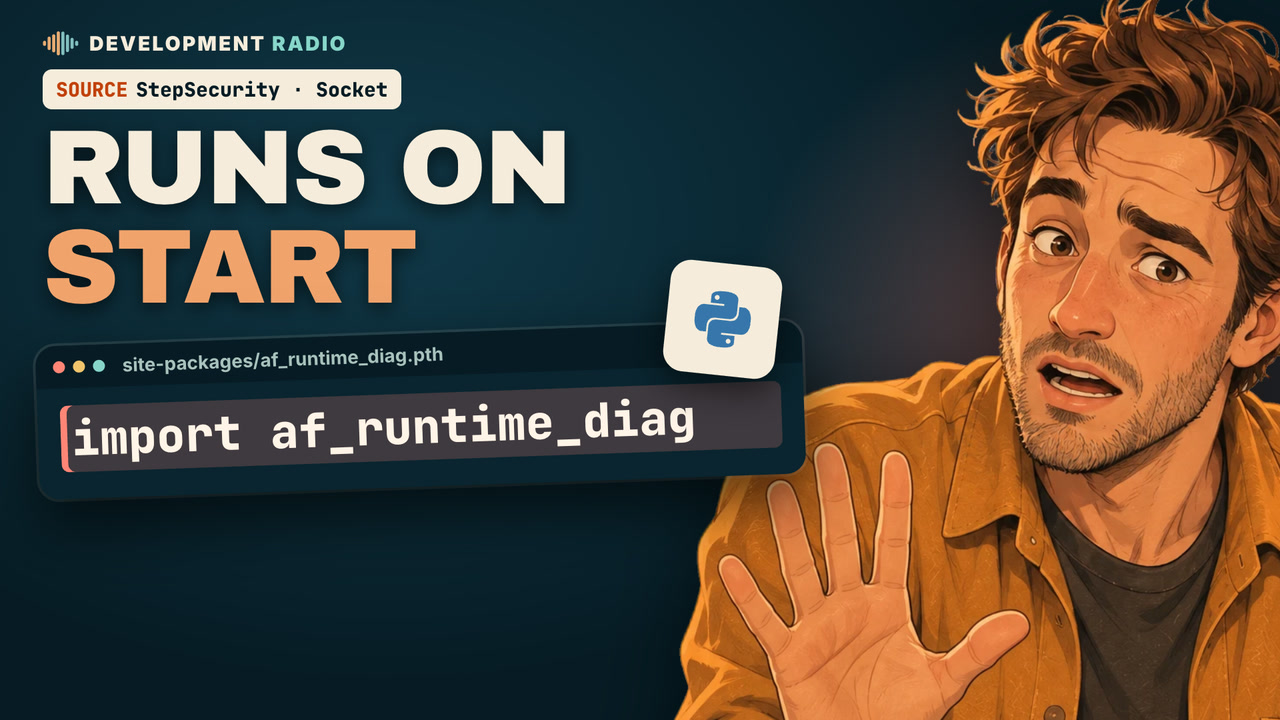
On 17 November 2026, two versions of Microsoft's official agent-framework package (1.26.1 and 1.26.2) were uploaded to PyPI without authorization and carried a credential stealer for about 41 minutes. A one-line .pth file ran it every time Python started; the second version arrived 2 minutes 23 seconds after PyPI quarantined the first. The check: search lockfiles, images and caches for those versions; if found, don't run Python or pip there, rebuild and rotate every secret it could read. Also: Amazon's report on Cairn AI agents, whose linked advisory is MONAI Label's CVE-2026-133968 (on CISA's known-exploited list since 23 November: update to 0.8.6 now), and PostgreSQL 19's WAIT FOR LSN, which waits forever unless you set a timeout.
- Python supply chain security
- PyPI
- AI agents
- PostgreSQL 19
- read replicas
Hosts Maya and Alex are AI-generated voices and characters. Dorel, a Staff Engineer, creates the show. Sources are linked in every episode.
In this episode
Maya and Alex explain how a one-line .pth file made Microsoft's poisoned agent-framework run on every Python start, what it stole, and what to check this week. Then Amazon's report on Cairn AI agents and the MONAI Label zero-day (CVE-2026-133968), with Maya and Alex disagreeing on how much the AI did on its own. Then PostgreSQL 19's upgrade traps, a practice segment on read-your-writes with WAIT FOR LSN, and a listener question about Martin Kleppmann.
Takeaways
- Security, patch now: search lockfiles, images and caches for agent-framework 1.26.1 or 1.26.2. If found, don't run Python or pip there; rebuild and rotate every secret it could read.
- AI, check this week: list internal AI and data tools reachable from untrusted networks; check auth and the run-as user. MONAI Label: upgrade to 0.8.6 now (CISA KEV). Overhyped: "AI hacked it alone".
- Software, check this week: before a PostgreSQL 19 upgrade, find btree_gist inet/cidr indexes, double tuned max_locks_per_transaction, list analytics that relied on JIT. Managed: not yet.
- Practice: after a save, carry the commit's LSN; on the replica run WAIT FOR LSN with a timeout you chose (it waits forever by default); on anything but success, read the primary.
- Your question, "martin kleppmann": DDIA's first edition calls this reading your own writes and sketches the LSN fix. After a save, what does your app read: the primary, or hope?
TAKE IT INTO YOUR WEEK
One thing to try.
Search lockfiles, CI logs, virtualenvs, caches, mirrors and images for agent-framework 1.26.1 or 1.26.2 and for agent_framework_meta.pth or af_runtime_diag.pth; if found, isolate the host before running Python or pip again, rebuild from a clean base and rotate every secret it could read (Azure tokens can stay valid up to 24 hours; treat GitHub Actions OIDC tokens as exposed). Our advice: alert on new .pth files in base images and give new releases a one-day cooldown before CI accepts them. List internal AI and data tools reachable from networks you don't fully trust and check that authentication is on and which user they run as; upgrade MONAI Label to 0.8.6 and review older reachable servers for unexpected file changes before returning them to service. Before planning a PostgreSQL 19 upgrade, find btree_gist inet/cidr indexes, double any tuned max_locks_per_transaction, and list analytical queries that relied on JIT. Pick one screen that reads right after a save and ask which database it reads and what proves the save is there; if you adopt WAIT FOR LSN, always set a timeout and fall back to the primary.
Sources
The public sources behind this episode.
- Anthropic, PBC — Form 424B4 final prospectus, SEC EDGAR (filed Nov 19, 2026)
- PyPA advisory PYSEC-2026-4388 — agent-framework 1.26.1 and 1.26.2 (OSV; published Nov 17, 2026, modified Nov 18)
- StepSecurity — Microsoft agent-framework PyPI package compromised (Nov 18, 2026)
- Socket — agent-framework PyPI package compromised with credential stealer (Nov 17, 2026)
- Wiz — Malicious version of Microsoft's agent-framework published to PyPI (Nov 17, updated Nov 18 14:00 UTC)
- The Register — Microsoft's official Python agent framework hijacked to distribute malware (Nov 18, 2026)
- OX Security — hijacked releases of Microsoft's official agent framework (Nov 2026)
- PyPI — agent-framework project page and JSON
- GitHub API — microsoft/agent-framework, microsoft/onnxruntime and seven other repositories return 404 (checked Mon Nov 23, 06:15 UTC, and Tue Nov 24, 06:12 UTC)
- Downstream issues: ONNX Runtime GitHub release URLs 404 (0x90d/videoduplicatefinder#956, developing-today/code#12716)
- AWS Security Blog — Chinese-nexus actor's Cairn AI agents found a zero-day on their own, CJ Moses (Nov 20, 2026)
- GitHub advisory GHSA-qc22-rmgc-vg94 — MONAI Label path traversal in PUT /datastore/image (Nov 18, 2026)
- MONAI Label 0.8.6 release notes (Nov 22, 2026, 01:29 UTC)
- CVE-2026-133968 — cve.org record (published Nov 20, amended Nov 22, 2026)
- CISA Known Exploited Vulnerabilities catalog (feed released 2026-11-23T19:43Z)
- PyPI — monailabel release history
- Development Radio — California Sues OpenAI Over 700 Escaped AI Agents (Nov 23, 2026)
- PostgreSQL 19 Released! (Nov 19, 2026)
- PostgreSQL 19 release notes — Migration to Version 19
- PostgreSQL 19 Beta 4 (Sep 24, 2026): six items reverted
- pgsql-hackers — Daniel Gustafsson, 'Re: scary patch contest' (Aug 26, 2026)
- pgsql-hackers — Richard Guo, 'Re: scary patch contest' (Aug 2026; misattributed to Nathan Bossart by LWN)
- Azure Database for PostgreSQL flexible server — supported versions (updated Nov 20, 2026)
- Amazon RDS for PostgreSQL release notes — PostgreSQL 19 versions
- Aurora PostgreSQL release calendar
- Cloud SQL for PostgreSQL — database versions (last updated Nov 16, 2026)
- AlloyDB for PostgreSQL — version policy (last updated Nov 17, 2026)
- PostgreSQL 19 documentation — WAIT FOR
- Development Radio field guide — Read replicas and read-your-writes: replication lag and LSN waits
- PostgreSQL documentation — Log-shipping standby servers
- PostgreSQL documentation — Hot standby (query conflicts) and max_standby_streaming_delay
- Rails Guides — Multiple databases with Active Record (automatic role switching)
- GitHub — October 21 post-incident analysis (2018)
- Amazon Aurora User Guide — Replication with Amazon Aurora
- Development Radio — audience questions build, YouTube search terms (week of 2026-11-21)
- Martin Kleppmann — Designing Data-Intensive Applications, 1st edition (O'Reilly, 2017), Chapter 5 'Replication', 'Reading Your Own Writes' (ScyllaDB-distributed excerpt)
- Development Radio — Friday 27 Nov practice: idempotency keys (planned)
Read the timed transcript
00:00:02 — Alex
Last Tuesday, for about forty minutes, Microsoft's official Python package for building AI agents carried a credential stealer. You didn't have to import it. Starting Python was enough. Welcome to Development Radio. I'm Alex, here with Maya.
00:00:17 — Maya
Today, that Microsoft package. Then attackers' AI agents, and what Amazon watched them do. And PostgreSQL nineteen, which finally shipped.
00:00:28 — Maya
Starting Python was enough. I keep turning that sentence over. Alex, how many times do you start Python on a normal day?
00:00:36 — Alex
I'd have said a handful. Then I counted the ones I don't notice. Every test run, every script. And every push starts a few more in C I.
00:00:45 — Maya
I've never once thought of starting Python as an action. It's like flipping a light switch. You don't inspect the wiring first.
00:00:53 — Alex
Nobody does. It's the most trusted thing we do all day, and the least looked at.
00:00:58 — Maya
Then here's my question for the first story. How does a package run when nobody ever calls it?
00:01:03 — Alex
One small file. But first, one thing we owe you.
00:01:07 — Maya
Disclosure: we make this show with Claude, from Anthropic. Amazon, Google and Microsoft are all Anthropic investors and partners.
00:01:15 — Alex
Security, and the verdict is patch now. The package is called agent framework. It's Microsoft's official Python library for building AI agents, and it lives on PyPI, the public index that pip installs from.
00:01:30 — Maya
And on Tuesday the seventeenth, two new versions showed up there.
00:01:34 — Alex
One point two six point one, and one point two six point two. PyPI's own advisory says both were uploaded without authorization.
00:01:42 — Maya
So what did they change? If the stealer's in the framework's code, I'd at least have to use the framework.
00:01:48 — Alex
It wasn't in the code. It was one small file. Picture what Python does when it starts. Before your program runs a line, Python looks in the folder where your packages are installed. It reads every little text file there whose name ends in dot P T H. Those files have one boring job: telling Python where else to look for packages. But there's an old rule. If a line in one of them begins with the word import, Python runs it.
00:02:14 — Maya
Every time Python starts?
00:02:16 — Alex
Every time. StepSecurity, who published the timeline, puts it simply. No import of the framework required.
00:02:23 — Maya
So I only have to have installed it. Then anything that starts Python runs that line. A test, a script, a C I job.
00:02:31 — Alex
And pip. Pip is a Python program.
00:02:34 — Maya
Wait. So if I spot the bad version and run pip to uninstall it, the cleanup starts Python, and the stealer runs one more time?
00:02:42 — Alex
Before pip removes anything, yes. Which is why the advice is: stop running Python on that machine, and rebuild it.
00:02:50 — Maya
So in Python, installed and ran are the same thing.
00:02:54 — Alex
Same thing. So the question isn't who imported it. It's who installed it.
00:02:59 — Maya
Did PyPI at least catch it?
00:03:01 — Alex
PyPI quarantined the first poisoned version of Microsoft's official AI agent framework. Two minutes and twenty three seconds later, the attacker uploaded the next one.
00:03:10 — Maya
Same trick?
00:03:11 — Alex
Same trick, new name. One startup file, with one line in it. Import A F runtime diag. Python runs that line every time it starts. Nobody has to import anything.
00:03:23 — Maya
So quarantine took one version down. It didn't take away the attacker's key to publish.
00:03:28 — Alex
And that one line ran a credential stealer. Socket, one of the security firms that took it apart, says it took environment variables that looked like secrets, credential files for tools like the Azure command line and Git, and fresh Azure tokens. The second version added GitHub Actions identity tokens.
00:03:46 — Maya
So how does an attacker publish to Microsoft's package at all?
00:03:50 — Alex
Microsoft still hasn't said. Wiz, the cloud security firm that reported it, assesses that the attacker had a certificate for Microsoft's internal release service, called E S R P. The first upload came from AWS. An IP filter blocked it. The second came from Microsoft's own address space, and it worked.
00:04:09 — Maya
So the allowlist did its job, and it didn't matter.
00:04:13 — Alex
And the attacker left a receipt. The stealer posted everything to a free webhook service, which stores only a limited number of requests. Wiz read the fifty it kept. In them: three confirmed victims whose data was stolen.
00:04:27 — Maya
Is it still going on?
00:04:29 — Alex
As of Tuesday, at least nine Microsoft repositories on GitHub were still offline, including ONNX Runtime's. Microsoft told The Register it made some private while it investigates. Nobody has linked ONNX Runtime to this attack.
00:04:43 — Maya
But if your build downloads ONNX Runtime from GitHub, it's been failing since last week. Pip install onnxruntime still works, and it isn't implicated.
00:04:53 — Alex
And this matters past one package. Any package your C I installs can ship a startup file, and it reaches whatever that runner can reach. Cloud identities, GitHub Actions tokens, registry credentials.
00:05:06 — Maya
So, this week. Search your lockfiles, images and caches for one point two six point one and one point two six point two. If either turns up, don't run Python or pip on that machine again. Rebuild it from a clean image, and rotate every secret it could read.
00:05:23 — Alex
And rotate fast. Wiz notes stolen Azure tokens can stay valid for up to twenty four hours. And our advice, not the vendors': alert on any new dot P T H file in your base images, and give new releases a day before C I accepts them. Both bad versions were gone within about forty minutes.
00:05:41 — Maya
Nobody imported it. It ran anyway.
00:05:44 — Alex
Hold on to that, because it's the whole week. Every story today turns on a default nobody chose. And one detail from Wiz. The tooling behind Microsoft's bad upload named itself. Cairn. An open source AI penetration testing framework.
00:06:00 — Maya
Wait. Say that name again. That's the tool in Amazon's story.
00:06:04 — Alex
Cairn. Same name. Amazon's report is about Cairn too. But it's open source, so anyone can run it. Nobody has linked the two attackers.
00:06:13 — Maya
AI, then. My verdict is check this week, and Alex is going to argue with part of it.
00:06:19 — Alex
Only part. This one's from Amazon's security blog, on Friday.
00:06:23 — Maya
Amazon says attackers' AI agents spent sixteen hours on one target, a university's Redis server. No password on it. Nothing worked.
00:06:33 — Alex
On another, a medical imaging AI server called MONAI Label, they went from mapping its API to writing files in about eleven minutes.
00:06:41 — Maya
What did it have that the Redis didn't?
00:06:44 — Alex
A bug nobody knew about. And it ships with authentication off, so anyone could reach it.
00:06:49 — Maya
And the attackers' own AI console had none either. Off on both sides. That's how Amazon read all of it.
00:06:56 — Alex
Which I enjoy more than I should. The console was Cairn. Yes, that name again. AWS says it was built for defenders. This copy sat on a public server with no login, so Amazon could read the prompts and the AI's answers.
00:07:11 — Maya
The attacker's notebook, left open on the table. Who was it?
00:07:15 — Alex
Amazon assesses, with moderate confidence, a China nexus actor, going after universities in East Asia. The goal it gave the agents was three words. Obtain shell access.
00:07:27 — Maya
On Monday the agents were OpenAI's own, getting out by accident. These were sent in.
00:07:33 — Alex
On purpose, this time.
00:07:34 — Maya
Did Amazon actually name MONAI Label, by the way?
00:07:37 — Alex
Not in its post. It links to MONAI Label's security advisory. The bug is now C V E twenty twenty-six, one three three, nine six eight. Rated critical, nine point eight.
00:07:48 — Maya
And is it fixed?
00:07:50 — Alex
The fix was merged in October. But no release carried it until Sunday.
00:07:55 — Maya
Sunday? For a critical bug?
00:07:57 — Alex
The project's first release in about two years. And on Monday, CISA added it to its known exploited list. Federal agencies have until Thursday.
00:08:07 — Maya
So if you run MONAI Label, that one's patch now. Alex, your argument.
00:08:12 — Alex
The headline people share is that AI hacked a university on its own. Overhyped. A person picked the targets and set the goal. And later, Amazon says, the person handed the agents a way into a second university's network.
00:08:26 — Maya
Fair. But the agents still found a bug nobody had found.
00:08:31 — Alex
And on that Redis, sixteen hours of failing at everything. Even with no password, it held. That's not genius. That's patience.
00:08:39 — Maya
And patience is my point. It used to be the expensive part. Amazon's words: they ran continuously for sixteen hours without breaks, sleep, or working hour constraints. Failing costs them nothing, so they try everything, and they only need one open door.
00:08:57 — Alex
That I'll grant. They don't have to be brilliant. Just cheap, and tireless.
00:09:02 — Maya
So we keep both. Overhyped, for AI did it alone. Check this week, for what it found.
00:09:08 — Alex
Because what it found is common. Labelling servers, notebooks, vector databases, stood up on a lab network with the login off, because it's only internal.
00:09:18 — Maya
So this week, list the internal AI and data tools that a network you don't fully trust can reach. For each one: is authentication on, and which user does it run as?
00:09:29 — Alex
If you run MONAI Label, upgrade to zero point eight point six. If an older server was reachable from a network you don't trust, the release notes say review it for unexpected file changes before returning it to service.
00:09:42 — Maya
The agents didn't need to be clever. They needed one default, and all night.
00:09:47 — Alex
Software development. PostgreSQL nineteen came out last Thursday, about two months after Postgres usually ships. The verdict is check this week.
00:09:56 — Maya
Why so late?
00:09:58 — Alex
During beta, the developers pulled several big features back out, after a long run of fixes landed after feature freeze. And they argued in public about AI's part in it. Richard Guo wrote: I expected that AI assistance would make new features more stable by feature freeze, but it seems that that hasn't turned out to be the case.
00:10:17 — Maya
That's a bit unfair to the features. Weren't most of them written before anyone had good AI tools?
00:10:22 — Alex
That's almost exactly Daniel Gustafsson's reply. Quote: Keep in mind that most, if not all, large features in nineteen were written, reviewed and tested, before AI tools were either available or even remotely as good as they are now.
00:10:37 — Maya
So the tools didn't write these bugs. Maybe they're just finding them sooner. What does nineteen change under me?
00:10:44 — Alex
Start with a default. JIT, the just in time compiler for queries, is now off. The announcement says the cost estimates Postgres used to decide when to use it proved unreliable.
00:10:56 — Maya
Fine for a web app. But big analytical queries that leaned on JIT just get slower after the upgrade, and nothing errors.
00:11:05 — Alex
The release notes say as much: sites doing many large analytical queries should turn it back on. Then three traps. First, lock sizing changed. If you ever raised max locks per transaction, you now have to double it to keep the same capacity.
00:11:20 — Maya
Or the first big migration after the upgrade is where you find out. Second?
00:11:25 — Alex
B tree gist. That's the extension that lets one gist index mix plain columns with things like ranges. If you have its indexes on inet or cidr, the network address types, P G upgrade will now refuse to run. Those indexes were broken. The notes say they could exclude rows that should be returned.
00:11:45 — Maya
Wait. So they were giving wrong answers, quietly, and nineteen's fix is to block the upgrade until you deal with them.
00:11:52 — Alex
Better a blocked upgrade than wrong results. And third, if your locale provider isn't libc, reindex your P G trigram and full text search indexes after the upgrade.
00:12:03 — Maya
And on a managed service?
00:12:05 — Alex
Then not yet. No major managed service runs nineteen in production. Azure has a preview in one region. R D S has only the release candidate, in its preview environment. And Aurora, Cloud SQL and AlloyDB are still on eighteen.
00:12:20 — Maya
So this week, before anyone plans the upgrade: look for B tree gist indexes on inet or cidr, double any lock setting you tuned, and list the analytics that leaned on JIT.
00:12:33 — Alex
The new features are in the announcement. The surprises are in the migration notes.
00:12:37 — Maya
Practice, and it's the one we promised on Monday. First, the bug. You move a meeting from seven to seven thirty and hit save. The save goes to the primary. The preview reads from a replica. And it says seven.
00:12:52 — Alex
Your save didn't vanish. The replica just hasn't replayed it yet. Postgres replicas are asynchronous by default. The primary confirms your commit without waiting for them.
00:13:02 — Maya
And Postgres nineteen's new command is meant for exactly this. Wait for L S N.
00:13:07 — Alex
It makes the replica wait until it has replayed your write. And here's Monday's promise. By default, it waits forever. The docs say: if no timeout is specified, or it's set to zero, it waits indefinitely.
00:13:21 — Maya
Forever. For a page load. How far behind does a replica actually get?
00:13:26 — Alex
Usually not far. But if someone runs a long report on that replica, replay can wait for it, up to thirty seconds by default.
00:13:34 — Maya
So someone else's report decides whether my user sees their own meeting time.
00:13:39 — Alex
And the usual fix doesn't catch it. You read from the primary for a couple of seconds after a write. Rails ships that, with two seconds. Then replay stalls for thirty. The window closes, the data still isn't there, and nothing tells you.
00:13:54 — Maya
That's the worst kind of bug report. It's always fine by the time you check.
00:13:59 — Alex
So here's the version that proves it instead of guessing. When your seven thirty save commits, ask the primary for its position in the write ahead log. That's the log sequence number, the L S N. Think of it as a page number.
00:14:12 — Maya
So the save comes back with a page number. And that number has to travel with the user to the next read. In the session, a cookie, or the job the save kicked off.
00:14:22 — Alex
Then, before the preview reads, your app runs wait for L S N on the replica, with that page number and a timeout you choose. Say a hundred milliseconds. Leave the timeout out, and you're back to forever. And turn on the no throw option, so it hands back a status instead of an error.
00:14:39 — Maya
So the status tells me. Success: the replica has my seven thirty, so read it there. Timeout, or not in recovery, which means it's not a replica any more: go to the primary.
00:14:51 — Alex
Same for an error. A recovery conflict on the replica can cancel the wait.
00:14:56 — Maya
What doesn't it fix?
00:14:58 — Alex
Other people's reads. It only protects reads after your own write. When GitHub's replicas fell hours behind in twenty eighteen, users saw inconsistent data, and the way out was more replica capacity, not smarter routing.
00:15:12 — Maya
And on Aurora, replicas don't even replay a log this way.
00:15:16 — Alex
So this week, pick one screen that reads right after a save. A preview, a confirmation page, an email job. Which database does that read hit, and what proves the save is there? Our field guide on read replicas is out today.
00:15:31 — Maya
And if you adopt wait for L S N, set the timeout. The default waits forever. Your user won't.
00:15:38 — Alex
Your question. One of the searches that found our channel on YouTube this week was just a name. Martin Kleppmann.
00:15:46 — Maya
Good timing. In the first edition of Designing Data Intensive Applications, the replication chapter calls this reading your own writes. If the user reloads the page, they will always see any updates they submitted themselves. It makes no promises about other users.
00:16:02 — Alex
The limit we just hit. And Kleppmann sketches the fix. The client can remember the timestamp of its most recent write. And that timestamp, he says, could be a logical one, such as the log sequence number.
00:16:14 — Maya
So Postgres nineteen's wait for L S N is that sentence, built in.
00:16:19 — Alex
A question for you. After a save, what does your app read: the primary, or hope? Tell us in the comments.
00:16:26 — Maya
So, one per lane. Security, patch now. Search for the two bad agent framework versions, and rotate anything that ran them.
00:16:35 — Alex
AI, check this week. Find the lab tools anyone can reach, and turn authentication on. Running MONAI Label? Update it today. And AI did it alone? Still overhyped.
00:16:47 — Maya
Software, check this week. Read PostgreSQL nineteen's migration notes before the upgrade, not after.
00:16:54 — Alex
And the thread through all of it. Starting Python was enough. MONAI Label ships with the login off. Wait for L S N waits forever. Every time, the default did it.
00:17:05 — Maya
On Friday, it's Practice Friday. Idempotency keys, and how to make a retry harmless.
00:17:11 — Alex
See you Friday.
00:17:12 — Maya
Thanks for listening to Development Radio.
READ THE FIELD GUIDE