
Optimizely Hack Put Malware on 178 Big Sites, Plus the Nginx RCE Five Teams Found and Java4Shell
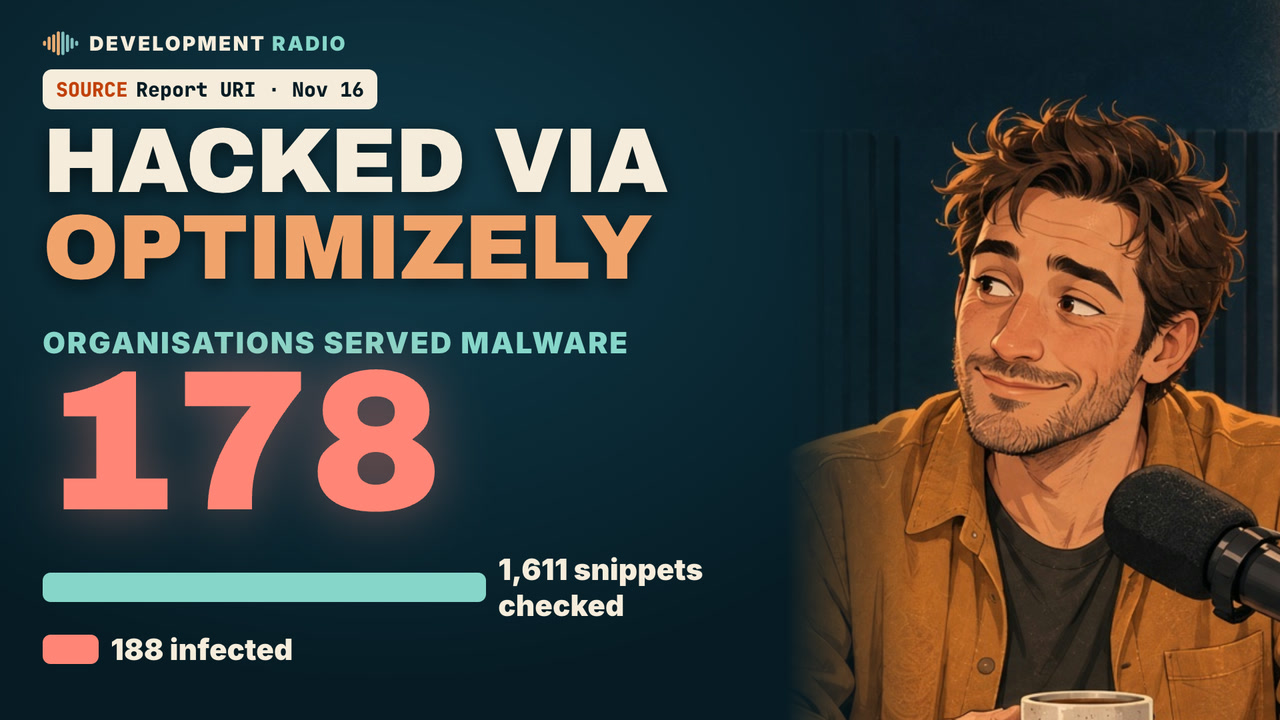
A flaw in Optimizely's signup flow let an attacker put card skimmers and wallet swappers in the Optimizely scripts of 178 organisations (Report URI's count); a content security policy stopped it on 24 sites. The same week, Nginx's HTTP/2 flaws CVE-2026-123007 (in the code since 1.9.5, 2015) and CVE-2026-123633 became an unauthenticated remote code execution advisory on 18 November 2026, reported separately by five research teams; they need HTTP/2 enabled and are fixed in 1.30.7 and 1.31.9. Wiz: "Complexity can no longer be relied upon as a barrier to discovery or exploitation." Java4Shell (CVE-2026-114938) hits OpenJDK 17.0.6+ on x86-64 with AVX-512: patch, or set -XX:-UseBASE64Intrinsics and restart.
- Nginx HTTP/2
- supply chain
- content security policy
- Java
- patching
Hosts Maya and Alex are AI-generated voices and characters. Dorel, a Staff Engineer, creates the show. Sources are linked in every episode.
In this episode
An attacker used a flaw in Optimizely's account signup flow to put card skimmers and crypto-wallet swappers inside the Optimizely scripts of 178 organisations, Zoom, the BBC, CNN and GitLab among them. Maya and Alex start with the week's other giant: a bug from 2015 in Nginx's HTTP/2 flow control that became an unauthenticated remote code execution advisory on November 18, reported separately by five research teams, Wiz with its AI scanner among them. They work out why a bug's age no longer protects you and what to check on Monday: versions, http2 in your configs, ingress defaults and the HTTP/2-off stopgap. Then Optimizely and the content security policy that stopped it on 24 sites, and Java4Shell: a Base64 bug an AI found in an hour for under $200, after a human had posted the same trigger in a public OpenJDK pull request in September that Oracle then took over privately.
Takeaways
- Nginx CVE-2026-123007 (since 1.9.5, 2015) and CVE-2026-123633 need HTTP/2 enabled. Fixed in 1.30.7 / 1.31.9; distro packages may backport without a version change, so read your distro's advisory.
- Search configs for 'http2 on;' and 'listen ... http2'; ingress-nginx's use-http2 defaults to true. Can't upgrade yet? Turn HTTP/2 off and reload (covers only the two HTTP/2 CVEs). gRPC: upgrade first.
- Five teams, Wiz with its AI scanner, reported the same Nginx bugs separately. A bug's age no longer protects you: plan patch timelines in days.
- Optimizely: a signup-flow flaw let an attacker put skimmers in customer scripts (Report URI: 178 organisations). List checkout/login scripts; tighten script-src and connect-src, report-only first.
- Java4Shell (CVE-2026-114938): OpenJDK 17.0.6+ on x86-64 with AVX-512; ARM64 unaffected. AI found it in an hour; a public PR had the trigger since Sep 9. Patch, or -XX:-UseBASE64Intrinsics (restart).
TAKE IT INTO YOUR WEEK
One thing to try.
Find every Nginx you run (hosts, containers, ingress controllers), confirm 1.30.7 / 1.31.9 or your distribution's patched package, search configs for http2 (both 'http2 on;' and 'listen ... http2'; in ingress-nginx the ConfigMap key use-http2), and turn HTTP/2 off until you upgrade wherever that is safe (not for gRPC) — it covers only the two HTTP/2 CVEs, so it does not replace the upgrade; list every third-party script on your checkout and login pages, ask who can change what each serves without your deploy, and tighten script-src and connect-src starting in report-only mode; check every Java service's version and host CPU, move to your vendor's patched build, and use -XX:-UseBASE64Intrinsics (JVM restart required) as a stopgap.
Sources
The public sources behind this episode.
- Wiz Research — Unauthenticated Remote Code Execution in NGINX: CVE-2026-123633 and CVE-2026-123007 (Nov 18, 2026)
- nginx.org — nginx security advisories (checked 2026-11-19)
- nginx.org — Module ngx_http_v2_module documentation
- Kubernetes ingress-nginx — ConfigMap options (use-http2)
- Hacker News — Unauthenticated remote code execution in Nginx (front page Nov 18, 2026)
- SecurityWeek — Exploitation of Critical NGINX Vulnerability Begins (May 18, 2026)
- Report URI (Scott Helme) — World's Largest Brands Infected With Malware Via Optimizely (Nov 16, 2026; updated Nov 17)
- BleepingComputer — Optimizely supply chain attack infects major brands' sites with malware (Nov 16, 2026)
- iTWire — Optimizely says it has fixed flaw used to inject malicious scripts (Nov 17, 2026; updated Nov 18)
- Hacker News — Optimizely compromised, served malware on Zoom, GitLab (front page Nov 17, 2026)
- Calif — Java4Shell: Write once, RCE everywhere (CVE-2026-114938, Nov 17, 2026)
- Hacker News — Java4Shell: RCE in OpenJDK when processing Base64 (front page Nov 17, 2026)
- openjdk/jdk pull request #32781 — 8392044: AVX-512 Base64 decoder overwrites output buffer on short padded tail
- Hacker News — Someone reported java4shell bug in September 2026 (front page Nov 19, 2026)
- adoptium-support issue #1480 — comments by the PR #32781 author (albertnetymk), Sep–Oct 2026
- Qualys — How to Find, Mitigate, and Patch the Critical Java4Shell Flaw (CVE-2026-114938) Now (Nov 17, 2026)
- ComplexDiscovery — Harvard researchers find AI coding agents shifted the bottleneck to code review (Nov 2026), on Chen & Stratton, 'Artificial Intelligence in the Firm: Bottlenecks in Software Production' (working paper, Aug 4, 2026 version)
Read the timed transcript
00:00:02 — Maya
Welcome to Development Radio. I'm Maya, here with Alex. Today it's Nginx, the web server, plus Optimizely and a Java bug. And a question every team thinks it has already answered. How fast do we actually patch? Alex, honest answer. Your laptop says an update is ready. What do you click?
00:00:23 — Alex
Remind me tomorrow. Every time. I have a laptop that has been reminding me tomorrow since about March.
00:00:30 — Maya
I'm worse. I click remind me tonight, because it sounds responsible. And then tonight I'm in the middle of something, so it becomes tomorrow anyway.
00:00:38 — Alex
Tonight is just tomorrow with better marketing.
00:00:41 — Maya
And at work it's the same thing, with a ticket. Somebody opens a ticket that says, upgrade the web server. It gets a label. The label is tech debt. And then it sits in the backlog like a houseplant nobody waters.
00:00:54 — Alex
But it's still alive. That's the trick. Nobody closes it, so technically it's being handled.
00:01:01 — Maya
Here's my excuse, though. The old version works. It's been working for years. Old code feels safe. It's battle tested.
00:01:09 — Alex
I like battle tested. It's a phrase that quietly assumes somebody would have noticed by now.
00:01:15 — Maya
Well, this week that assumption had a rough week. A bug from twenty fifteen turned up in Nginx. And it wasn't found by one team. It was found by five.
00:01:25 — Alex
Five separate teams. Same bugs. At least one of them using AI to look.
00:01:31 — Maya
So that's our question today. If an eleven year old bug can be found by five teams at once, how fast do you actually have to patch? And what do you check first on Monday?
00:01:41 — Alex
Then two more. An attacker slipped malware into Optimizely scripts on Zoom and BBC pages. And an AI found a Java bug a human had already posted in public. In September.
00:01:54 — Maya
Okay, I want all of that. But Nginx first.
00:01:58 — Alex
So. On Wednesday, November eighteenth, F5, the company behind Nginx, shipped a security release. And Wiz Research published a write up titled, word for word: Unauthenticated Remote Code Execution in Nginx.
00:02:12 — Maya
Unauthenticated. So no login. Somebody on the internet sends bytes, and ends up running code on my server. Okay, before I panic. Which Nginx? Every one of these comes with a, but only if.
00:02:26 — Alex
Good instinct. There are two bugs Wiz rates critical, and it says it plainly. Quote: Both vulnerabilities require HTTP two to be enabled on the affected Nginx server.
00:02:38 — Maya
HTTP two. Where one connection carries lots of requests at once, and each side tells the other how much data it's allowed to send.
00:02:46 — Alex
Right, that's flow control. Nginx keeps a counter for it, the send window. When a request gets cancelled, Nginx throws away the data it had queued and gives that allowance back to the counter. Wiz found it gives it back without checking the maximum.
00:03:01 — Maya
And a counter over its limit, in C, is never just a big number.
00:03:05 — Alex
It isn't. A later check wraps around. The oversized value eventually becomes a negative length, and in the code that sends data over TLS, that turns into a memory copy out of bounds. And here's the age. Quote: The integer underflow vulnerability dates back to Nginx one point nine point five, in twenty fifteen.
00:03:25 — Maya
Twenty fifteen. So that's the battle tested code. That's my houseplant ticket.
00:03:30 — Alex
Eleven years of battle. And Wiz didn't find it by reading code all night. Their words: Wiz Research used Wiz Atlas, the harness powering Wiz's AI Code scanning solution, to discover both vulnerabilities.
00:03:44 — Maya
So they pointed AI at Nginx and found an old bug. Honestly, in twenty twenty six, that's the headline I'd expect.
00:03:52 — Alex
Then here's the one you wouldn't. Five teams found the same Nginx bugs, separately. When Wiz reported one, F5 wrote back: another research team had previously reported the same vulnerability. Wiz credits four by name. Ikotas Labs, Metnir, Rapid Seven and Xint.
00:04:10 — Maya
Wait. Eleven years of nobody, and then five teams at once?
00:04:15 — Alex
All five reported it to F5 before one release fixed it. So much for battle tested.
00:04:20 — Maya
Then the age of a bug isn't protecting me anymore. If the good guys found it five times, assume somebody you don't like found it once.
00:04:28 — Alex
That's the assumption I'd plan with. Fine for years just meant nobody had a cheap way to look. Wiz says it more bluntly. Quote: Complexity can no longer be relied upon as a barrier to discovery or exploitation.
00:04:41 — Maya
Okay, but how bad is it really? Can somebody run this tomorrow?
00:04:46 — Alex
Not with Wiz's code. Wiz built working exploits in a lab, on official Nginx builds, and it isn't releasing them. But Wiz also says, quote: Typical memory safety mitigations such as ASLR do not protect against these issues.
00:05:01 — Maya
Then my next worry. Is HTTP two even on by default? Because if it's off, most of us are fine.
00:05:08 — Alex
In upstream Nginx, the docs say the http2 directive defaults to off. But plenty of configs were copied from snippets with http2 on the listen line. And some tools switch it on for you. The Kubernetes community ingress nginx controller has a setting called use http2, and its documented default is true.
00:05:29 — Maya
So off in the docs, and possibly on in everything we actually deployed.
00:05:34 — Alex
Possibly. So it's a check, not a guess. And Wiz says a CDN or a WAF that terminates HTTP two may mitigate parts of the exploit. May. And only if nobody can reach your Nginx directly.
00:05:48 — Maya
Which is the thing everyone believes and nobody tests. Okay. Monday. What do I actually do?
00:05:55 — Alex
Find every Nginx you run, including the ones inside containers and ingress controllers, and check the version. The fixed releases are one point thirty point seven, stable, and one point thirty one point nine, mainline. If yours comes from a Linux distribution, read the distribution's advisory, because they often backport a fix without changing that number.
00:06:16 — Maya
Then search the configs for http2. And if you can't upgrade this week?
00:06:21 — Alex
Wiz's advice is to turn HTTP two off on those servers. Set http2 off, and take http2 off any listen line. Reload, and make sure the old worker processes have actually exited. That only covers these two bugs, and the same release fixed others, so it buys time. It doesn't replace the upgrade.
00:06:41 — Maya
Unless you run gRPC through it. gRPC is built on HTTP two, so turning it off isn't an option. Those servers get upgraded first.
00:06:51 — Alex
And first means this week. Back in May, a different Nginx bug, nicknamed Nginx Rift, was being exploited days after its patch. SecurityWeek reported it, citing VulnCheck. The clock isn't a quarter. It's days.
00:07:06 — Maya
So the houseplant ticket gets watered. Okay. Story two. Optimizely.
00:07:12 — Alex
Optimizely runs experiments on websites. Green button or blue button. You put one Optimizely script on your pages, it's served from Optimizely's servers, and marketing changes the experiment without a deploy.
00:07:24 — Maya
Which is the selling point.
00:07:26 — Alex
And the plot. On Monday, November sixteenth, in Optimizely's own words, an unauthorized party exploited a vulnerability in the Experimentation account signup flow. They used it to add malicious JavaScript to some customer projects.
00:07:40 — Maya
The signup flow. So not one customer's stolen password. A hole in the vendor's front door.
00:07:48 — Alex
And through it, into other companies' pages. One hundred and seventy eight organisations had malicious code inside their Optimizely scripts. Zoom, the BBC, CNN, GitLab. Scott Helme at Report URI counted them. The code swapped crypto wallet addresses and skimmed card numbers typed into the sites' own forms.
00:08:08 — Maya
Here's my problem. Every checklist says, only load scripts from domains you trust. They did.
00:08:15 — Alex
That's the twist. Helme's line: The malicious code arrived from the trusted host itself.
00:08:21 — Maya
So allowing a domain doesn't mean trusting the domain. It means trusting everyone who can write to it. Including, apparently, a signup form.
00:08:30 — Alex
Yes. And Helme checked the content security policies of affected sites. Twenty four blocked the payload. His words: What separated the twenty four protected sites from the rest was a restrictive script source.
00:08:43 — Maya
So, Monday. Open your checkout page and your login page and list every third party script. For each one, ask: who can change what this serves, without a deploy from us?
00:08:54 — Alex
Then tighten the content security policy. Script source lists only the hosts you need. Connect source limits where the page can send data. Start in report only mode, so you see what would break first.
00:09:06 — Maya
Which nobody does, because next Tuesday marketing adds a new tool and the policy blocks it.
00:09:12 — Alex
That's the real cost. A strict policy needs an owner. Still a cheaper meeting than explaining a card skimmer on your checkout page.
00:09:20 — Maya
Okay. You promised me sixty four A's and an equals sign.
00:09:24 — Alex
I did. It's called Java four Shell. On Tuesday, November seventeenth, a security firm called Calif disclosed a memory corruption bug in OpenJDK's Base64 decoder.
00:09:36 — Maya
Base64. The most boring code in the building.
00:09:39 — Alex
On newer Intel and AMD servers, Java decodes it with a fast path using AVX five twelve instructions. Calif says the corruption can be triggered by just sixty four A characters, followed by a single equals sign. The decoder writes past the end of an array. In their testing, that reached code execution without a login in default setups of Keycloak and Jira.
00:10:02 — Maya
Sixty four A's. That's a cat sitting on a keyboard. Where does the AI come in?
00:10:08 — Alex
The researcher, Quang Luong, had OpenAI's Codex audit Java's just in time compiler and its hardware fast paths. Most of what came back was junk. Then, quote: It took our own Quang Luong an hour to discover the vulnerability, and two more hours to develop the first working exploit. The total token cost was less than two hundred dollars.
00:10:30 — Maya
Two hundred dollars. That's less than the team dinner after the incident. So that's the twist? An AI found it in an hour?
00:10:38 — Alex
No. Here's the twist. An AI found Java four Shell in one hour. But in September, a human had already posted what looks like the same bug, in public. An OpenJDK pull request. Same decoder. Same sixty four A's and an equals sign.
00:10:55 — Maya
Wait. In public? Since September? What happened to it?
00:10:59 — Alex
Publicly, nothing. No reviews. Closed unmerged in November. But the author wrote that Oracle asked him not to proceed, and then took it over.
00:11:08 — Maya
So nobody ignored it. It went private. And for ten weeks, the trigger sat on GitHub where anyone could read it.
00:11:15 — Alex
Until the fix shipped on November seventeenth, the same day Calif published. So it was handled. It still took ten weeks. That's the Nginx story again. Finding the bug is cheap now. The slow part is everything after.
00:11:29 — Maya
Which is the study people argued about all week. A Harvard working paper looked at about seven hundred companies that adopted AI coding agents. About thirty percent more code. Finished work didn't measurably go up. And the time from opening a pull request to merging it went up by about half.
00:11:48 — Alex
So the bottleneck moved to review and release. Same shape as the Java story. The finding took an hour. Everything after took weeks. That's the Staff level takeaway for me. AI made finding and writing cheap. Reviewing, merging and deploying didn't get cheaper. If you want to be faster than an attacker, that's the pipeline to invest in.
00:12:08 — Maya
Okay. Monday check for Java.
00:12:11 — Alex
Check the Java version of every service. Calif says seventeen point oh point six and later are affected. ARM servers aren't. It needs a newer Intel or AMD CPU with AVX five twelve, and one image can land on different instance types, so check the hosts, not just the image. Move to your vendor's patched build. Until then, there's a JVM flag that turns the Base64 fast path off. It needs a restart. It's in the show notes.
00:12:38 — Maya
So that's the week. An eleven year old Nginx bug, found five times. A trusted script, poisoned through a vendor's signup form. And a Java bug an AI found in an hour, that a human had posted in public back in September.
00:12:54 — Alex
All three end the same way. The bug was already there. Looking just got cheap.
00:12:59 — Maya
Which brings me back to the laptop. I'm clicking update tonight. Actually tonight.
00:13:05 — Alex
I'll believe it tomorrow. And we want to hear from you. What's the oldest thing still running in front of your app? Tell us in the comments.
00:13:12 — Maya
Mine's a houseplant. Thanks for listening to Development Radio.